Slingshot

Introduction
Slingshot drops you into a Kibana instance instead of a terminal. No shell to pop, no exploit to write, just an apache_logs index full of ModSecurity audit data and a set of questions about an attack that already happened against a web app running on slingway.thm. The job is reconstructing it: which recon tool touched the server, which credentials got used, how the attacker got a foothold, and what they actually walked out with.
Theory
Kibana’s Discover view is a query bar over an Elasticsearch index plus two things that matter for a room like this: the field sidebar on the left, which shows a value breakdown for whatever field is selected, and the expanded-document view, which lets you drill into one hit and read every field a log line carries, not just the ones shown in the results table. The query bar itself uses KQL, Kibana Query Language, field: value pairs, wildcards, and filter chips you can pin on top of a free-text search. None of that is exotic once you’ve used it a few times, but I hadn’t, going in.
Walkthrough
Finding the attacker. The log corpus only had a handful of distinct remote IPs in it, so narrowing down which one belonged to the attacker wasn’t the hard part. Once I had it, pivoting on request.headers.User-Agent for that address laid the rest of the recon out on its own: Nmap, Gobuster, and Hydra all show up as literal substrings in the user agent strings the tools send by default. Each one answered a room question by itself, the Gobuster one came from combining request.headers.User-Agent: Gobuster with response.status: 404, since a directory brute-force is mostly a wall of misses with the odd hit buried in it.
Credentials via Hydra. Filtering the same user agent down to response.status: 200 instead of 404 gives the one request that actually worked, a GET /admin-login.php carrying an Authorization: Basic header.
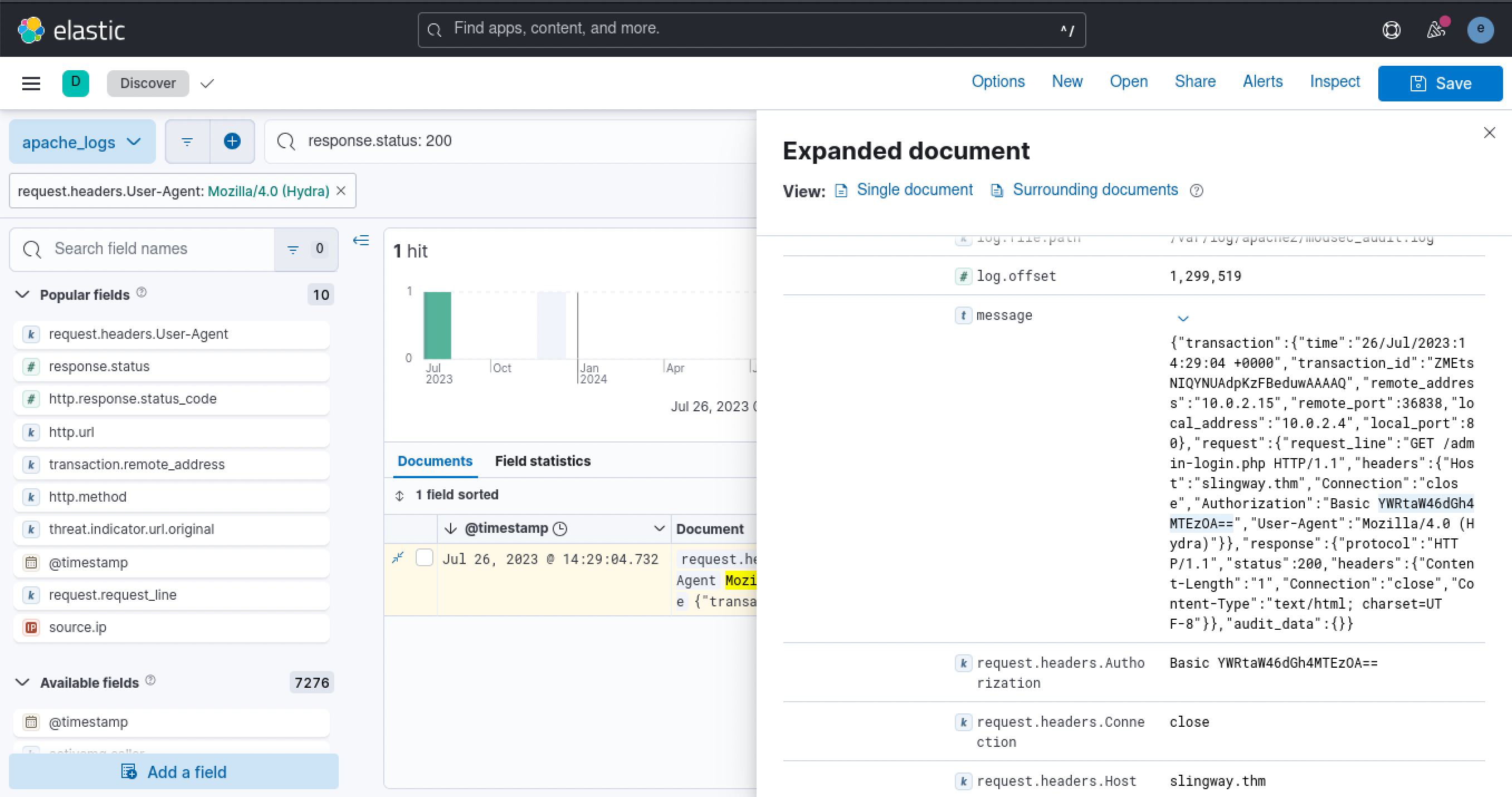
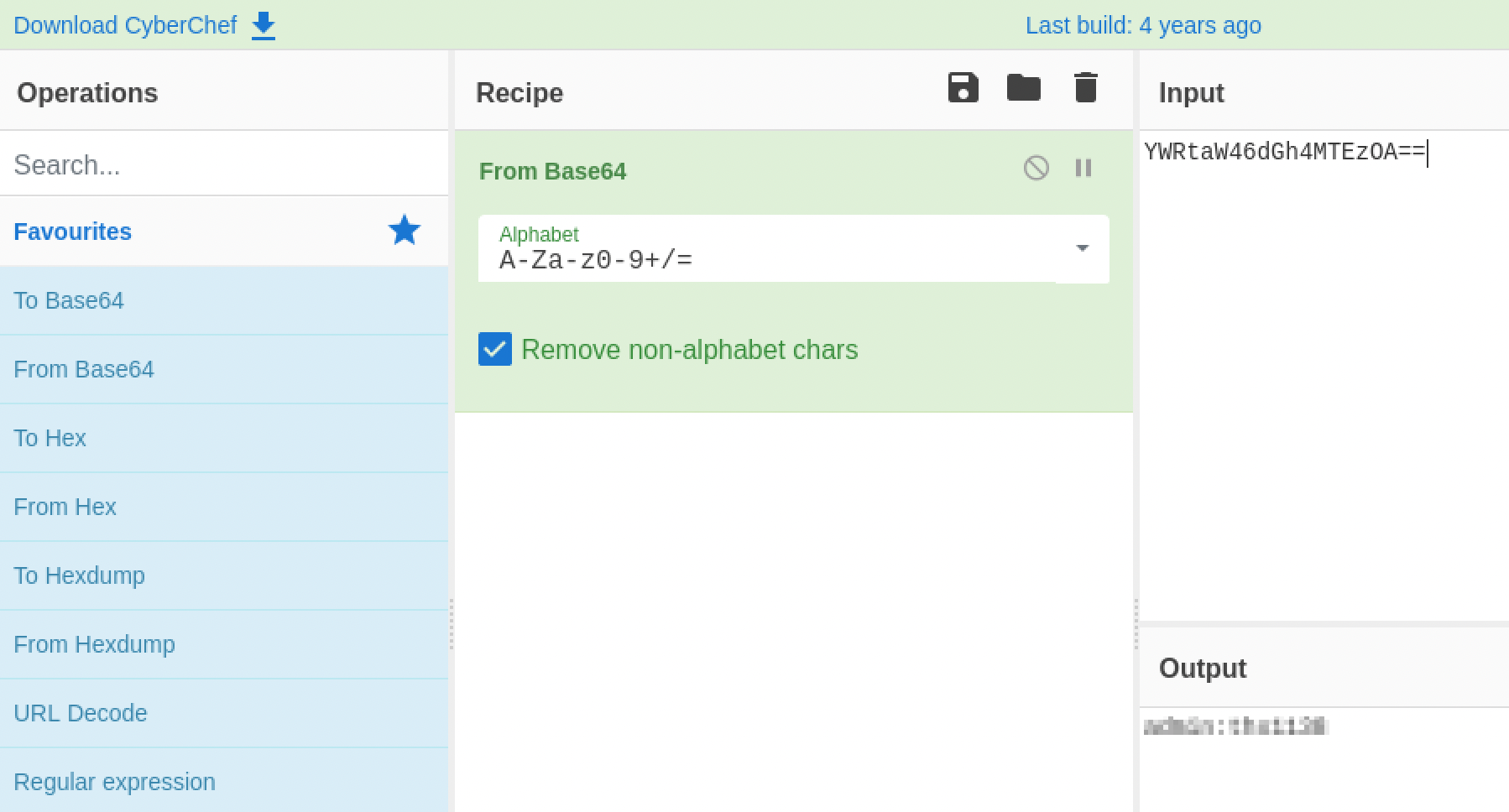
Basic auth is just base64 over user:pass, so that header decodes on its own. I ran it through CyberChef’s From Base64 operation and got the plaintext username and password out, [redacted].
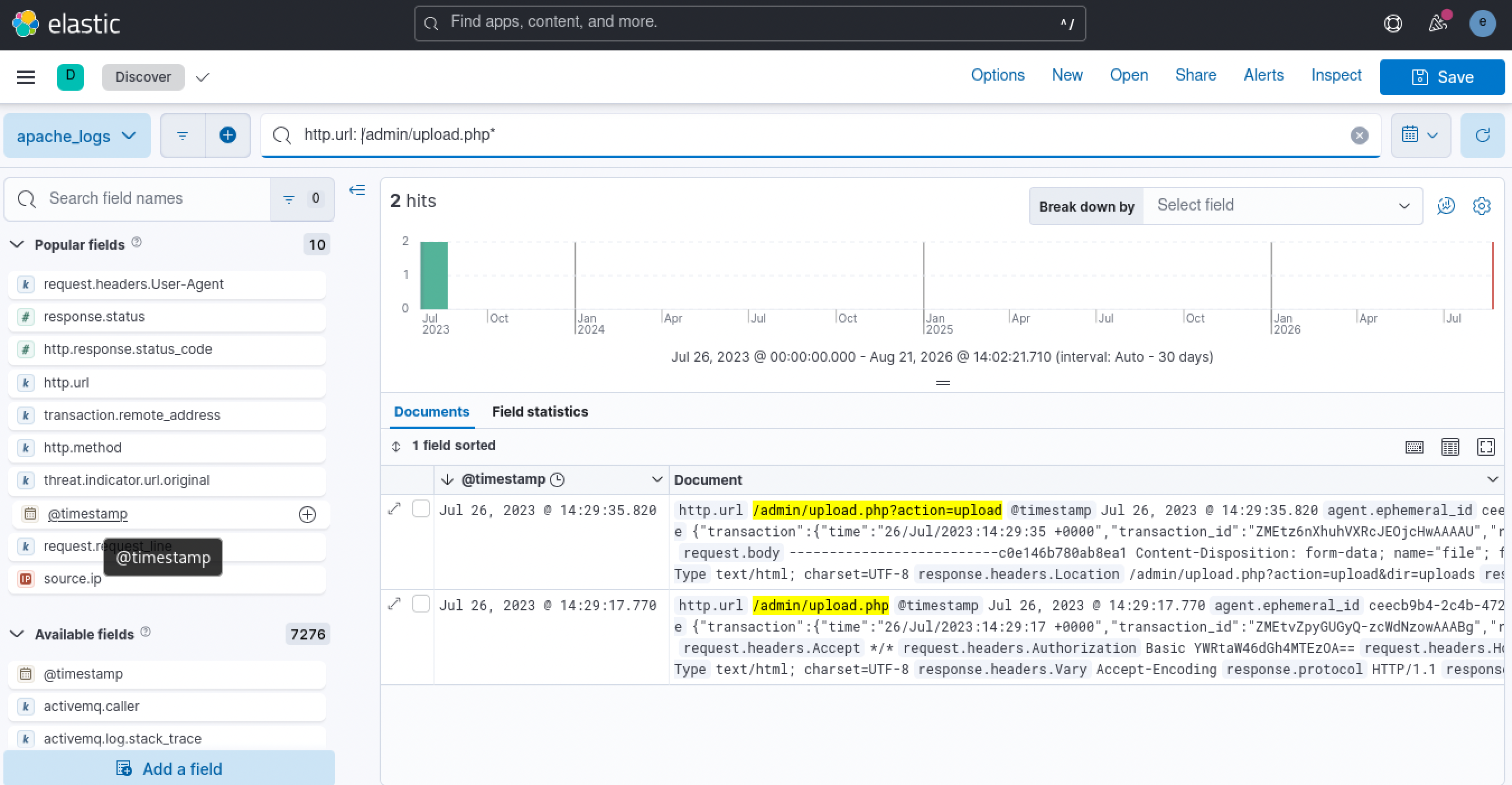
Getting a foothold. With working admin credentials, the next question was how they turned into code execution. Filtering on http.url: */admin/upload.php* turns up exactly two hits, one that hits the endpoint plain and one carrying a multipart POST.
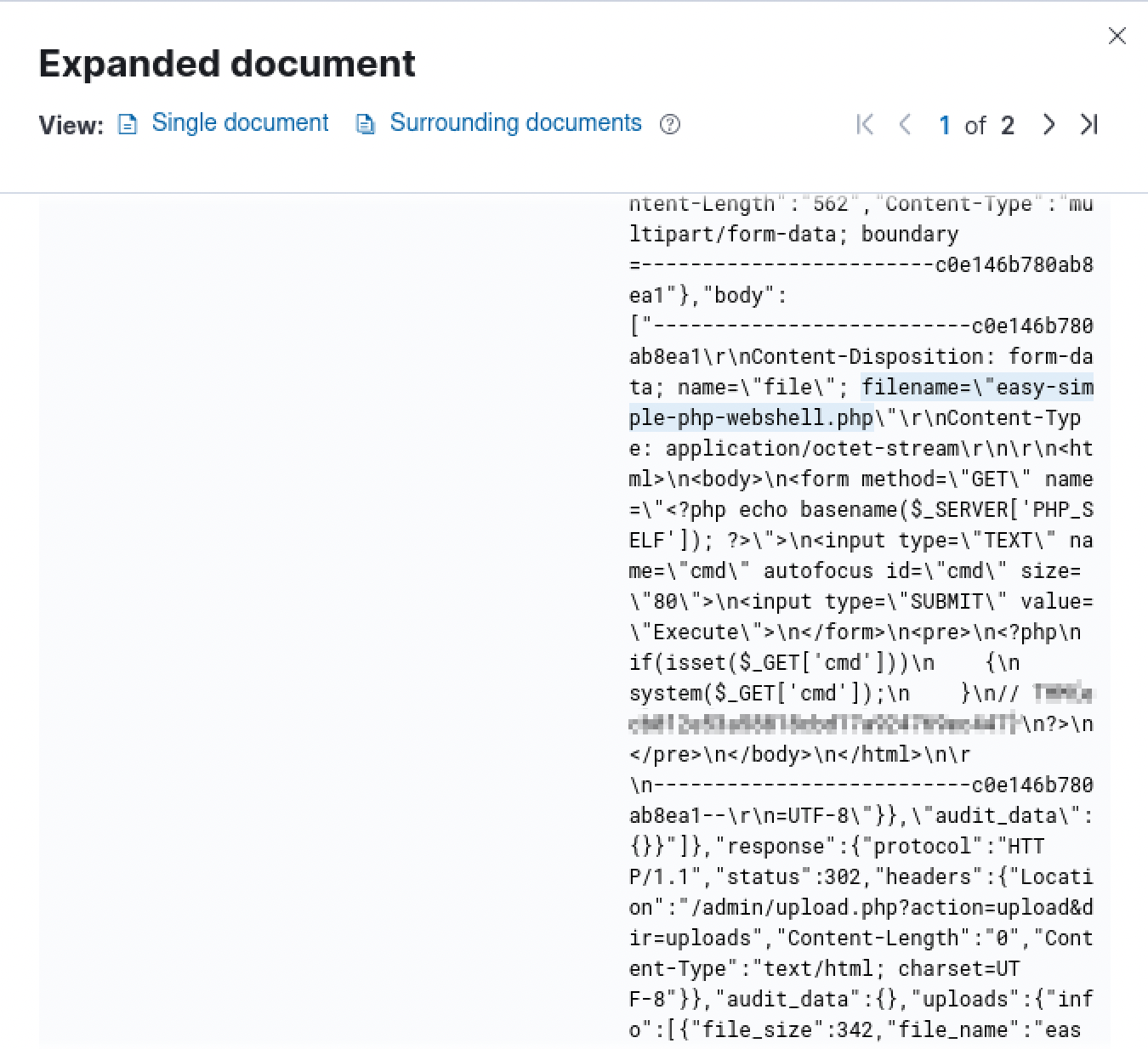
The POST body is a file upload named easy-simple-php-webshell.php, a minimal PHP shell that echoes the running script’s own filename and runs whatever comes in through a cmd GET parameter via system(). The response confirms the upload landed under /uploads, and the file’s own source, sitting right there in the request body, carries the room’s flag in a comment.
The first command run against that shell, once it was live, was whoami. Not creative, but it’s the obvious first thing to check once you’ve got arbitrary command execution and want to know what you’re working with.
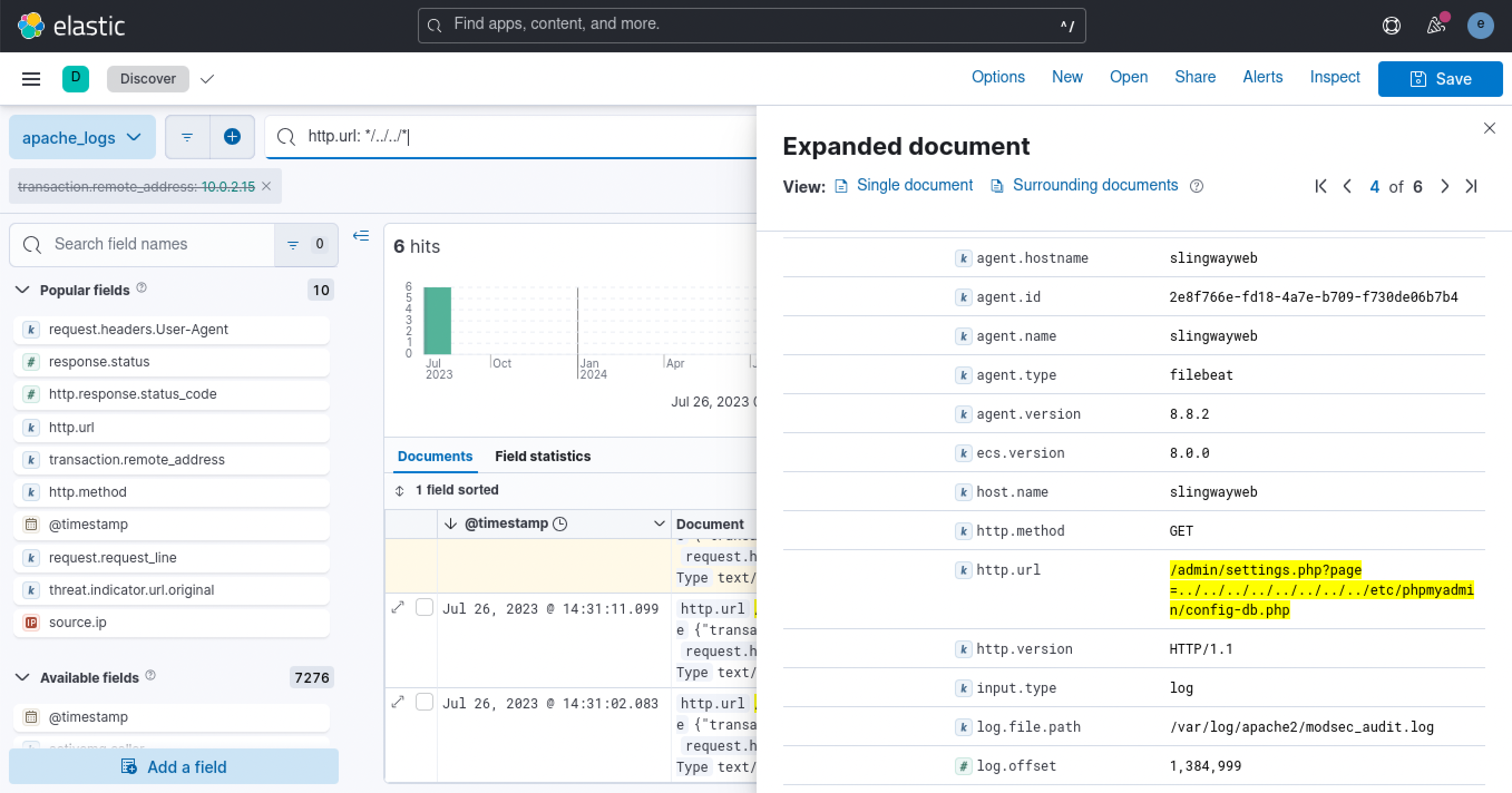
Local file inclusion. The next question pointed at reading a file outside the intended path, so I filtered http.url: */../../* to catch anything doing path traversal. That turned up this request line, walking up seven directories and back down into /etc/phpmyadmin/config-db.php:
1
GET /admin/settings.php?page=../../../../../../../etc/phpmyadmin/config-db.php HTTP/1.1
I hadn’t worked with LFI much before this, so I looked up what actually makes an endpoint like settings.php?page= vulnerable in the first place.
What I looked up: how LFI actually works
It comes down to a script trusting a path the user controls. Something like include($_GET['file']) pulls in and runs whatever that parameter points to, without checking that it stays inside an expected folder. ../ sequences exploit that directly: each one walks the include one directory up, so stacking enough of them steps clean out of the web root and back down into wherever the target file actually lives on disk, /etc/passwd being a common test target since it’s readable on pretty much any Linux box.
What comes back depends on what’s on the other end. A plain config file just gets read out, which is what happened in this room, phpMyAdmin’s own database credentials landing in the response. But if the same include can be pointed at a file the attacker controls instead, a poisoned log entry, an uploaded image with PHP code tacked onto it, reading a file turns into running one, and LFI stops being information disclosure and becomes code execution.
The expanded document confirms the request landed on the real host, slingwayweb, going after phpMyAdmin’s own database config file, credentials for the database itself.
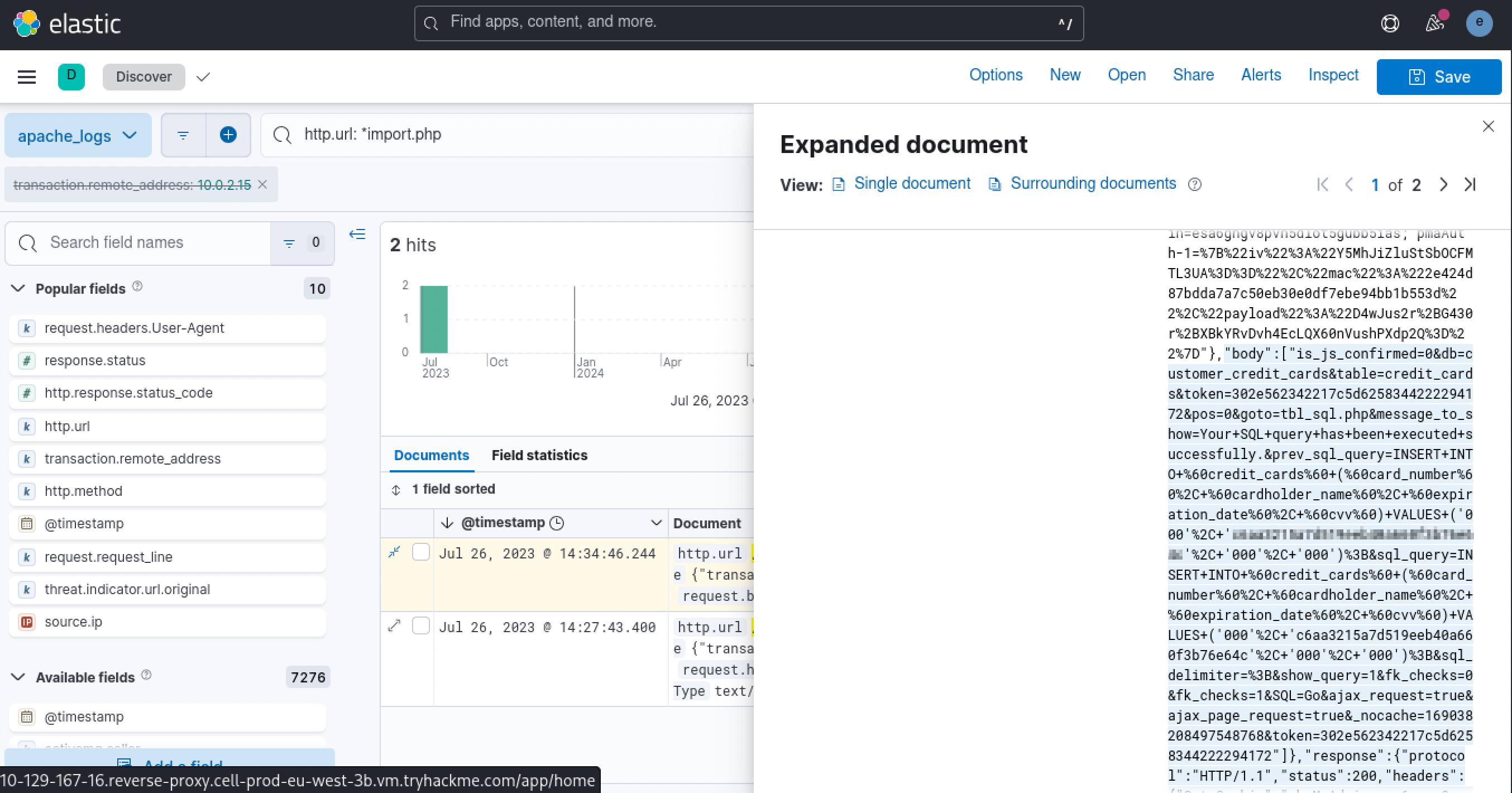
The SQL injection. The last piece was figuring out which database got read from and written to. I didn’t have a direct filter for that yet, so I guessed SQL first, phpMyAdmin was already in the picture from the LFI, and searched for anything hitting import.php. That was the right guess: the request body is a raw SQL injection, an INSERT INTO against a credit_cards table sitting inside a customer_credit_cards database, padding placeholder values into card_number, cardholder_name, expiration_date, and cvv columns.
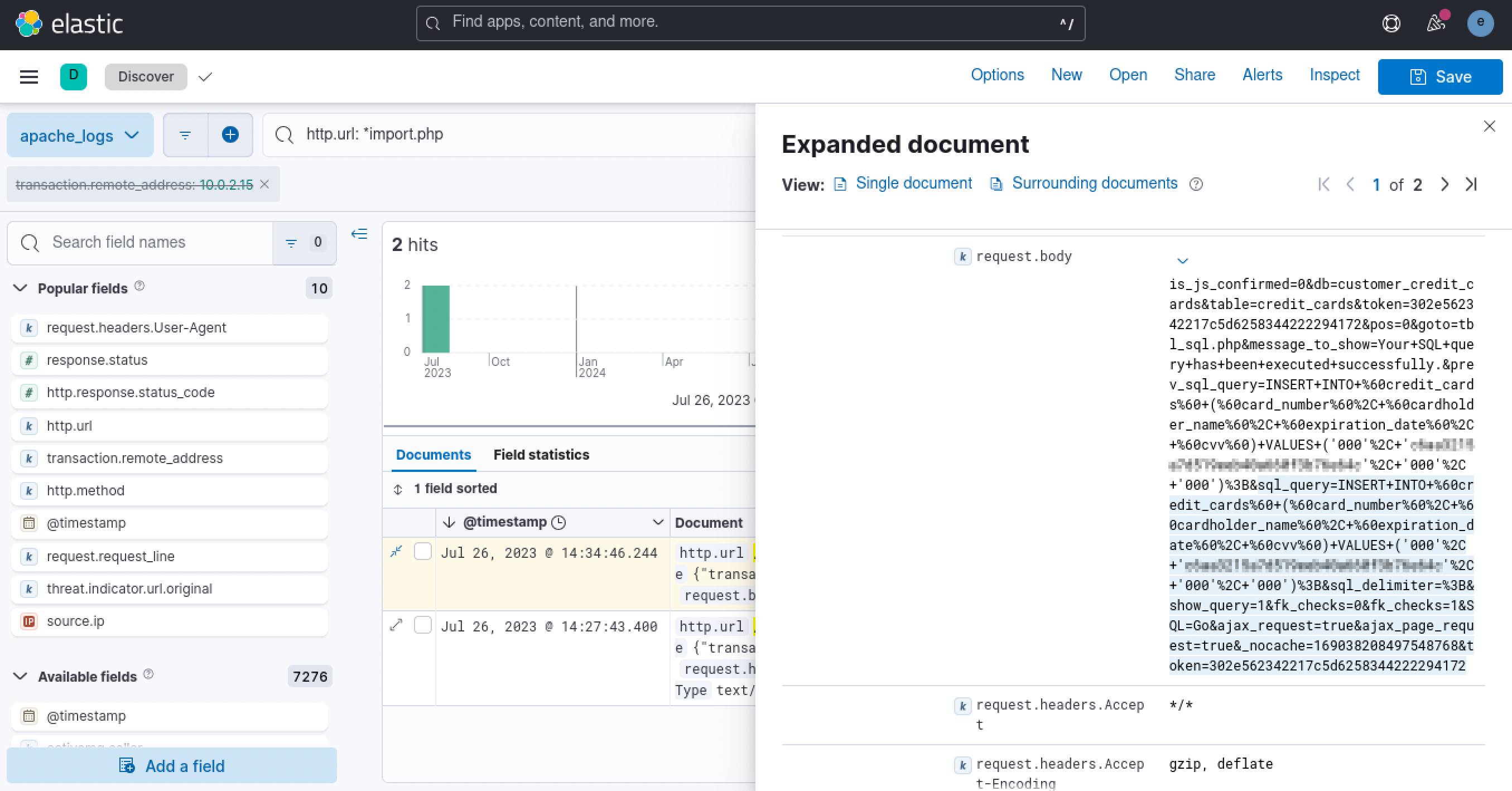
A second hit against the same endpoint carries the same query again, further confirmation this wasn’t a one-off test but the actual exfiltration path the attacker used against phpMyAdmin’s SQL import feature once they had the database credentials from the LFI step.
What I’d actually want fixed here. Every step in this chain traces back to one missing control. Hydra got working credentials because admin-login.php never rate-limited or locked out repeated failed attempts, that’s the kind of gap a handful of response.status: 401 events from the same source in a short window should catch on its own. The upload endpoint accepted a .php file with no extension or content-type check, an upload feature that needs to exist at all should whitelist file types server-side, not just trust the client. The LFI held because settings.php?page= passed user input straight into an include with no allow-list of valid pages, ../ sequences in a URL parameter is cheap to flag. And the SQL injection succeeded because phpMyAdmin’s raw SQL import feature was reachable at all from an app-admin session, that’s an access-control question as much as an input-validation one, a database admin tool shouldn’t be one stolen cookie away from a compromised web app. None of these needed a zero-day, they needed basic input handling and access separation that wasn’t there.
Lessons Learned
I didn’t stumble into this room, I picked it on purpose to get better at KQL. I’d already spent time on TryHackMe’s Regular Expressions room and the RegEx Learning app beforehand, and gone through the Advanced ELK Queries room once on its own, specifically to build up query syntax I could actually reach for instead of just recognizing when I see it. This room was the next rung on that same ladder: working mostly through the field sidebar and short, specific filters instead of one long query, which is still slower than someone fluent in KQL would be, but it’s real practice against a real log corpus, not a tutorial.
The attack chain itself, once reconstructed, wasn’t complicated: weak credentials, a webshell upload, LFI into a config file, SQL injection through an admin tool, one step feeding the next. I had to look up how LFI actually works, but not because the room’s traversal payload was clever, ../ repeated a few times isn’t a hard idea. What made this room worth doing wasn’t the attack’s difficulty, it was that reconstructing it from logs instead of running it live is a different skill, and specifically the one I came here to practice.